
Minister Fred Mitchell Addresses SOAS on the Role of Small States in a Changing Global Order Small States Must help shape Global Order
FOR IMMEDIATE RELEASE – 11, March 2026. LONDON, UNITED KINGDOM – The Minister of Foreign Affairs of The Bahamas, the Hon. Fred Mitchell, delivered an address on 11 March 2026 at the Centre for International Studies and Diplomacy, SOAS University of London, reflecting on the role of small states in shaping an evolving global order and reaffirming The Bahamas’ commitment to multilateral cooperation and a rules-based international system.
Opening his remarks, Minister Mitchell said it was a privilege to speak at SOAS, noting the institution’s longstanding reputation for examining international affairs from multiple global perspectives. In a time of geopolitical uncertainty, he said, such intellectual openness and engagement remain essential.
Representing The Bahamas, Minister Mitchell described the country as both a Small Island Developing State (SIDS) and a “large ocean state,” noting that the archipelago of more than 700 islands spans over 100,000 square miles of ocean at the crossroads of North America, Latin America, and the wider Caribbean.
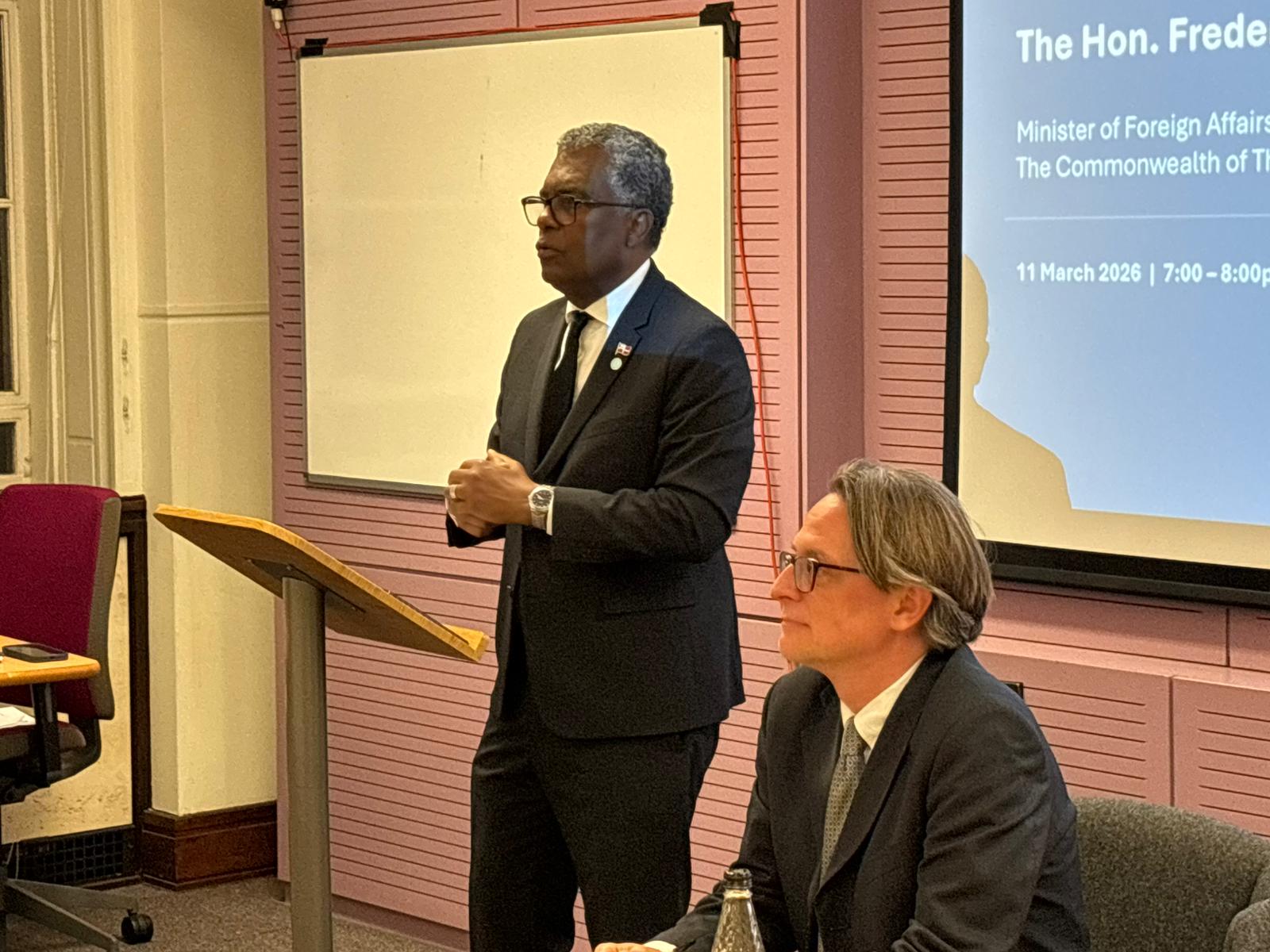
He explained that the purpose of his address was to explore how small states, though limited in size, possess strategic insight and diplomatic experience that allow them to navigate periods of global transition.
“We are living through a real and multi-dimensional transition in the international system,” the Minister said, pointing to intensified major power competition, technological rivalry, trade tensions, supply chain disruptions, and the expanded use of sanctions as instruments of foreign policy.
These developments, he noted, are placing significant strain on global institutions that were designed for a different era. However, he rejected suggestions that multilateralism is in decline.
“We are not witnessing the collapse of the international order,” he said. “Rather, we are living through an interregnum in which power is more contested, norms are more fragile, and institutions are expected to do more while commanding less public trust.”
Minister Mitchell emphasized that a particular concern for many countries in the Global South is the perception that international rules are not always applied consistently across states. When powerful actors appear to exempt themselves from obligations, they expect others to follow, he said, confidence in the system is weakened.
Drawing on the experience of The Bahamas and the Caribbean Community (CARICOM), the Minister said small states frequently must balance adherence to international principles with the realities of asymmetrical relationships with larger powers.
“In the diplomacy of small states,” he noted, “leaders often face the difficult task of balancing principle with survival.”
He also highlighted how global conflicts, and geopolitical crises often dominate the international agenda, leaving issues critical to vulnerable states, such as climate finance and development, crowded out of urgent diplomatic attention.
Turning to regional concerns, Minister Mitchell referenced the humanitarian challenges facing Cuba and the continuing instability in Haiti, issues that Caribbean states continue to address through advocacy and cooperation in international forums.
A major focus of the address was the existential challenge posed by climate change for The Bahamas and other small island nations. Minister Mitchell noted that approximately 80 percent of the landmass of The Bahamas lies within one metre of sea level, making the country particularly vulnerable to rising sea levels.

For that reason, he said, climate change remains the number one foreign policy issue for The Bahamas, as articulated by Prime Minister the Hon. Philip Davis.
“The science is clear,” the Minister stated. “For small island states such as The Bahamas, climate change is not theoretical, it is existential.”
Looking ahead, Minister Mitchell outlined several priorities for strengthening international cooperation. He urged small states to deepen cross-regional coordination, strengthen technical and legal expertise, and present themselves as architects of solutions rather than simply advocates for recognition.
He also called on multilateral institutions to reform access to climate and resilience financing, simplify procedures, and ensure that smaller states can participate fully in international negotiations.
Larger partners, he said, should support reforms that make global institutions more inclusive and provide predictable support for climate resilience and maritime security in vulnerable regions.
Minister Mitchell also underscored the importance of collaboration between academic institutions and policymakers, noting that scholarship plays a critical role in shaping international policy and ensuring that small states contribute to global intellectual discourse.
Concluding his remarks, the Minister reaffirmed The Bahamas’ commitment to defending a fair and inclusive rules-based international order.
“Small states bring clarity born of experience and the discipline required for coalition-building,” he said. “We do not seek special treatment. We seek a system equal to the challenges before all of us.”
Quoting civil rights leader Rev. Jesse Jackson, the Minister closed with a call for continued cooperation and optimism: “Keep hope alive.”
– END –
Photo Cred. Rucy Roosevelt Archer